
Martin County VINE Coverage
Kentucky VINE through VINELink receives information from participating local jails and Kentucky correctional institutions. For Martin County, that makes it useful for a person booked at Big Sandy Regional Detention Center and for a separate Kentucky Department of Corrections record. The regional jail is in Paintsville, yet it serves Martin County. Search the booking facility, not just the county where the criminal case began.
Coverage does not merge the two agencies into one record. A BSRDC custody entry can close when the jail transfers someone to Kentucky DOC. The jail entry may then look released while KOOL shows the person as an active state inmate. Kentucky advises registering on both the jail and DOC records when both exist. A VINE event describes the custody feed that produced it. It does not, by itself, prove a community release.
VINE does not replace the BSRDC booking and release sheet, the Martin County court order, or the state offender record. Each answers a different question. The facility record supplies the physical custody event. The court record can show bond, dismissal, sentence, or probation. KOOL supplies state correctional status and sentence information. Together they distinguish release from transfer.
Search Martin County VINE Records
Begin with enough facts to separate namesakes. A partial name or a jail or DOC identifier can start the search. Compare the facility, identifying number, middle name, suffix, age or birth information when shown. Do not connect a BSRDC result to a DOC result merely because the first and last names match.
- Open VINELink and choose Kentucky.
- Select Find an Offender and enter a partial name or known jail or DOC identifier.
- Open each plausible result and compare the identity and facility fields.
- Read the custody status and any facility or release date exactly as labeled.
- Search again for a separate jail or DOC record when the custody path may have crossed systems.
- Save the matched identifier before registering for notice.
If no result appears, change only one search term at a time. Try a known alias, remove the middle name, or use the identifier. Then use the broader Martin County released inmate search paths to check the jail record, court file, or agency that last held the person.
The official VINELink search screen starts with a state choice and Find an Offender search.
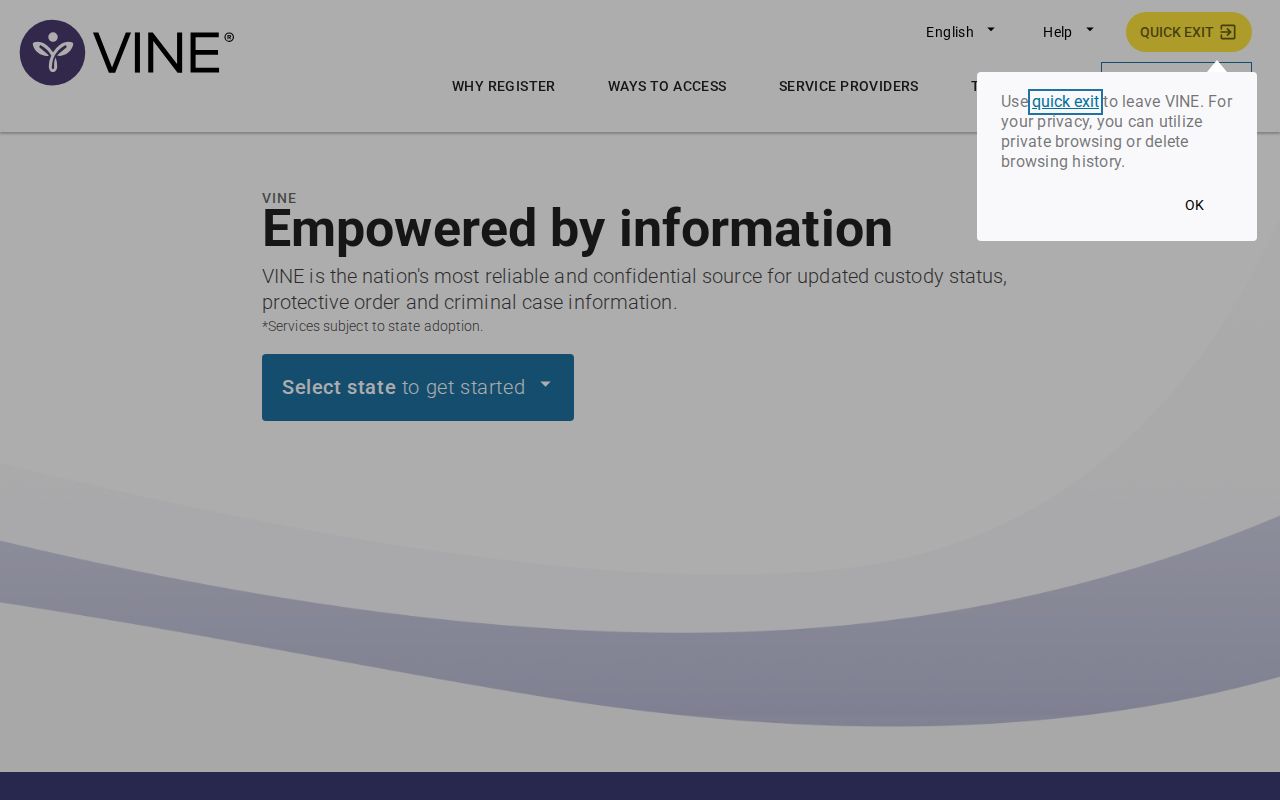
The screen is a search entry point. A matched record still must be checked against the correct person and custody agency.
Note: A missing name is not proof of release because spelling, source participation, processing, and transfer timing can affect results.
Martin County VINE Release Fields
A current result and a released result answer different questions. Kentucky's official description says a confined record gives custody status and institution contact information. When the person is no longer in that participating agency's custody, the result can give that status and a date released. It does not explain the court outcome or state that the whole sentence ended.
| Field | What it shows |
|---|---|
| Name or identifier | Helps match the person to the jail or DOC source record. |
| Custody status | States whether the source reports current custody or no longer in custody. |
| Facility contact | Identifies the participating institution to contact for a current confined record. |
| Date released | Marks the release event reported by that source, not the end of every legal obligation. |
| Status change | Can trigger notice of release, transfer, or another participating custody event. |
Keep the order date, physical release time, and VINE update time separate. A judge can sign an order before facility processing ends. A VINE alert can arrive after the source system posts. A transfer can close the first record while a second agency keeps the person confined.
Register Martin County Release Alerts
Registration begins only after the correct person and source record are matched. Kentucky permits telephone and email destinations. Telephone registration uses a four-digit PIN, which acknowledges a call and stops repeat calls for that event. Choose a number that can receive automated calls. Switchboards cannot be used.
- Select “Notify Me of Status Changes” on the matched record.
- Follow the prompts for a telephone number, email address, or both.
- Create and retain a memorable four-digit PIN for telephone notice.
- Register on a second matched record if both BSRDC and Kentucky DOC entries exist.
- Enter the PIN when a call arrives, then verify the event with the source agency.
Telephone registration is also available through Kentucky VINE at 800-511-1670 and permits two telephone numbers. Registration is confidential and anonymous. For a local jail release, Kentucky says calls repeat every 30 minutes for 24 hours or until the PIN is entered. For a state institution, attempted notice begins 72 hours before release. If advance notice is not possible, calls start after the event posts.
Kentucky VINE's Martin County Layer
Kentucky describes itself as the first state to deploy an automated statewide victim notification system. It grew from a Jefferson County system and reached statewide implementation in February 1996. That history matters because the statewide network can surface a BSRDC event and a separate DOC event without treating them as one continuous record.
The practical rule is to follow the custody chain. If the matched BSRDC record changes, ask whether the event was a community release or a handoff. When Kentucky DOC is the receiving agency, open KOOL and register on the state record too. A jail release alert can be correct about the regional jail while the person remains in state custody.
The Kentucky DOC VINE information page explains PIN use, callback practice, and notification limits.
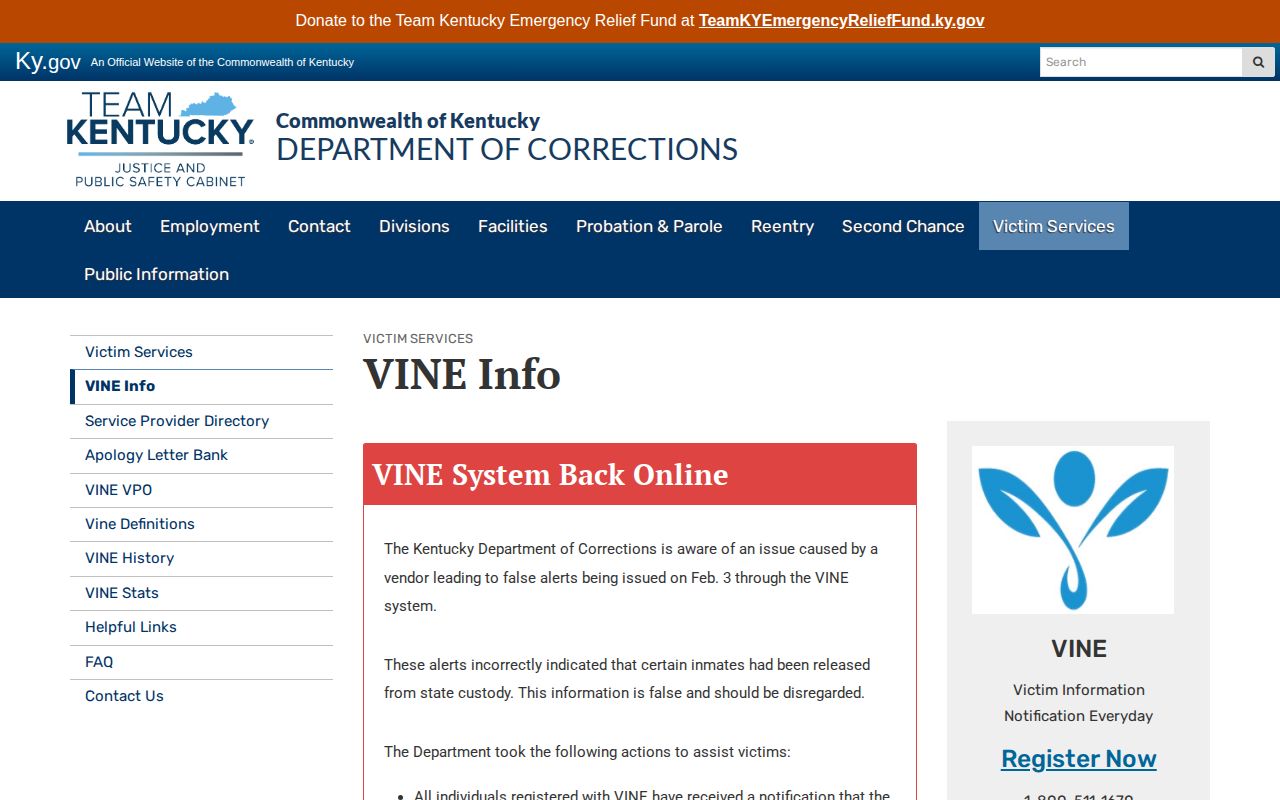
The official guidance also shows why an alert should start a verification check rather than end one.
Note: Register on each valid custody record because one agency's closed entry may coincide with another agency's new custody.
Martin County VINE Limits
VINELink does not cover a federal BOP sentence in the same way. USP Big Sandy and its satellite camp are in Martin County, but they are federal facilities. Search those people through the BOP Inmate Locator. A past BOP release date and Released result address BOP custody. They do not confirm whether federal supervised release continues or another authority holds the person.
Data can lag, and an alert can be wrong. Kentucky DOC documented false alerts caused by a vendor incident in February 2026. For an exact BSRDC event, call 606-297-5245 and ask whether the person was released or transferred, the date and time, the coded disposition, and the receiving agency if any. For a state record, compare KOOL status and location, then contact DOC Offender Information Services at 502-564-2433 if the labels conflict.
Written Kentucky DOC notice is another channel. The official instructions direct a request with the inmate's name or ID and the requester's contact information to the Office of Victim Services, P.O. Box 2400, Frankfort, KY 40602. A furlough question goes to the warden. None of these notices establishes court disposition, so retrieve the Martin County order when the legal basis matters.
Other official systems remain useful when the VINE result does not settle the custody path. The BSRDC public roster can show that a person is still confined at the regional jail, but its current-only setting means a person normally vanishes after release or transfer. KOOL can show an active inmate, community supervision, a DOC location, and sentence or parole fields. The Martin County court docket can identify the order that authorized bond, dismissal, probation, time served, or commitment. These sources should be reconciled rather than ranked by which one appeared first.
A VINE result marked no longer in custody is strongest when the identity, source facility, and date all match the known booking. It remains narrow evidence. It does not state that the person has no other case, warrant, detainer, sentence, parole term, probation order, or federal supervised release. If the purpose is to meet someone after release, confirm the place and time directly with the facility because the public alert does not promise an exit door, transport plan, or property pickup procedure.
ICE is another separate channel. A BSRDC event can reflect a handoff to immigration custody rather than a community exit. Ask the regional jail for the receiving agency and then use the ICE Online Detainee Locator when that agency is identified. Search by the nine-digit A-number and country of birth when possible, or by exact name and country of birth. An absent ICE result may reflect delay, an exclusion, or the limited period during which released results remain searchable.
Correction begins with the source agency. If an alert conflicts with direct facility information, preserve the alert time, the matched identifier, and the facility shown. Contact BSRDC for its feed, or Kentucky DOC for a state institution entry. The agency can verify its own custody event and correct source data. VINELink should not be asked to supply a court narrative or to decide whether supervision has ended.
A written release record is the best follow-up when durable proof is needed. For a BSRDC event, identify the person, approximate booking date, and booking number, then ask for the existing booking and release sheet. Request the release timestamp, disposition code, and receiving agency field. If the event involved Kentucky DOC, preserve the PID or DOC number and the current KOOL status. For a Martin County case, ask the clerk for the actual bond, dismissal, sentence, probation, revocation, or discharge order that fits the docket. Those documents explain separate parts of the event without asking VINE to do more than report a custody change.
The result should be described in source-specific terms. “No longer in BSRDC custody” is not the same as “free of all custody.” “Released from a Kentucky institution” is not the same as discharged from parole. “VINE alert received” is not a substitute for the agency timestamp. This narrow language protects against the most common mistake in Martin County searches: treating the end of one record as the end of every correctional or court obligation.